Everything you need to know about the Healdsburg SMART Station
SMART must make decisions that benefit the entire region by maximizing ridership, reducing congestion, and providing a compelling alternative to driving. Healdsburg's Downtown/Vine Street location best serves each of those objectives.
Note: Below are two opinion essays on the debate about where SMART should locate its Healdsburg Station, each by Santa Rosa YIMBY Local Leads. The first, by Adrian Covert, was published in the Press Democrat here on 11/18. The second, by Abby Arnold, was published in StreetsBlogSF here on 11/16.
For Healdsburg SMART Station, it's Downtown or Bust
By Adrian Covert
Nearly 75% of voters in Marin and Sonoma counties voted in June to continue investing in the Sonoma Marin Area Rail Transit system (SMART). Because we all pay for SMART, the transit system’s leadership has a unique responsibility to make decisions that are in the best interests of the entire region.
One such decision is where to locate the future Healdsburg station.
SMART is considering two possible locations for the Healdsburg station. The first, known as the downtown site, is located one block east of Healdsburg Plaza on Vine Street between North Street and Matheson Street, adjacent to the West Plaza parking lot. The downtown site is about 0.2 miles, or a four-minute walk, from the Healdsburg Plaza, according to SMART.
The second site is known as the Depot site, located near the city’s historic rail depot on Hudson Street, approximately 0.38 miles, or an eight-minute walk, from the Healdsburg Plaza, according to SMART. The location is near established residential neighborhoods, as well as businesses, schools and visitor destinations in south Healdsburg.
Of the two sites under consideration, the downtown site on Vine Street would serve the most riders, reduce traffic congestion by the biggest margin and best serve SMART’s continued northward march. SMART should choose it.
Transit competes with cars when service is safe, reliable and closely connects people’s points of origin and destination. That final piece is critical: when transit stops are too far from final destinations people will just drive. “Too far” in transit parlance is anything beyond a quarter mile. SMART’s own Larkspur Station, a half-mile from the Golden Gate Ferry Terminal, is a textbook example of how transit infrastructure goes underutilized when placed too far from either a connection or final destination.
Now let’s consider Healdsburg.
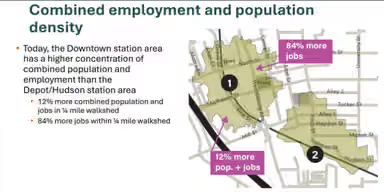
According to Census Bureau labor data, everyday 30% more people (nearly 5,000 total) commute into Healdsburg for work than leave Healdsburg to work elsewhere. Many of those Healdsburg jobs are downtown: SMART estimates there are 84% more jobs within a quarter-mile radius of the downtown site than the Depot site. What’s more, many of these jobs are at the restaurants, shops and tasting rooms that draw thousands of more people each day to downtown Healdsburg. By bringing workers and visitors closer to their final destinations, the downtown station location would maximize ridership, meaning less traffic along highway 101 and more parking within downtown Healdsburg for those who do drive.
The Depot site’s location would force people to travel a farther distance, nearly doubling the time it would take to walk from the station to the Healdsburg Plaza. We wouldn’t tolerate doubling the commute time onto drivers, nor should we tolerate it for transit drivers.
The planned development of 208 housing units near the Depot site won’t change this dynamic. First of all, a similar number of units are currently underway north of Healdsburg Plaza closer to the downtown site. Second of all, Healdsburg has a strict growth management ordinance that limits the development of market rate housing to just 30 units per year. Under this ordinance, it’s exceedingly unlikely Healdsburg will begin creating more outbound traffic than inbound anytime soon. It should also be noted that an effort (Measure O) to allow for more housing near certain high-transit corridors was rejected by Healdsburg voters in 2024.
One final consideration is the ability of both the downtown and Depot sites to connect with other transit, specifically the Sonoma County Transit Authority’s Route 60 bus. Route 60 is the region’s busiest bus service and comprises 20% of all SCTA boardings, averaging 158,000 annual boardings. Here too, the downtown site wins. The Depot Street site is too small to accommodate Route 60 and is more than twice the distance to the nearest existing stop than the downtown site. The Depot site would add unnecessary challenges for Route 60 riders and runs contrary to the recent $1.6 million grant received by Sonoma and Marin counties from The Metropolitan Transportation Commission to improve connectivity between its various transit systems.
SMART serves the entirety of Marin and Sonoma counties, not just any one city. It’s imperative that SMART make decisions which best position the system to compete with cars, reduce congestion and improve our quality of life. For the Healdsburg SMART station, it’s downtown or bust.
####
Call to Action: New Bay Area Train Station up for a Vote. Officials Need to Hear From you
By Abby Arnold
North Bay residents who recently voted to extend SMART train funding for another 30 years need to quickly weigh in on the location of the SMART station in Healdsburg, the next stop on the growing transit line. The SMART board, made up of elected officials from local governments in Marin and Sonoma counties, will decide where to build the station in Healdsburg, a city of 11,000 that restricts housing growth and therefore must import workers for its tourist economy. The “depot” site, preferred by Healdsburg residents, is a challenging half-mile walk to downtown, which will deter tourists as well as employees from taking the train. Ironically, the depot site is favored by Bill Galaher, the developer who was the only publicly recognized opponent of Measure B in June, which extended SMART funding.
As a Sonoma County resident who uses SMART to get to Petaluma, Rohnert Park, Windsor, and Novato, I’m acutely aware of the importance of the “last mile” in transit planning, along with the ability for passengers to connect seamlessly to bus lines when they reach the train station. The Healdsburg depot site does not meet either criterion. The Healdsburg bus center is in the heart of downtown, where SMART proposes to locate the new station. It makes a lot of sense for those people coming to Healdsburg to work, shop, attend movies and live theater, and otherwise enjoy the town, or to reach more distant destinations by bus. Sonoma County bus route 60, serving Healdsburg, is the highest ridership transit line in Sonoma County Transit’s entire network.
The SMART board is holding a public hearing on Wednesday, Nov. 18, and will choose the site at its December 16 meeting. Now is the time to speak up in support of a station in the city’s vibrant historic plaza – a hub of jobs, shopping, recreation, and transit connections – instead of the Depot site, a location further south of downtown that provides far less access to jobs and housing and would result in significantly less ridership and network connectivity.
Riders across the region who use SMART can do three things to help support the downtown site:
- Fill out this survey, which is open until Monday November 30th
- Send a letter urging SMART board members to choose the downtown site
- Sign up to give public comment at the Wednesday November 18th SMART Board Meeting
SMART’s decision about the Healdsburg station location has large implications for ridership, bus transfers, SMART operations, and housing and job access. As SMART looks toward expansion well beyond Healdsburg, the needs of all transit users in the North Bay should be the basis upon which station siting is informed.
The station location is critical because of the access it provides to the North Bay community. In part due to high housing costs, 84% of Healdsburg’s workforce lives outside of the city limits. 42% of those workers live in places that are currently or will soon be served by SMART service. That means SMART can achieve a reverse peak ridership of people traveling from other parts of Sonoma and Marin County, such as Santa Rosa and the Canal District, to work in downtown Healdsburg jobs. At the same time, increasing numbers of SMART riders are using the service for recreation and leisure. These are potential customers for Healdsburg’s downtown businesses.
SMART’s analysis makes a compelling case for the downtown station. Opposition as expressed at a recent Healdsburg City Council meeting focused on parking and traffic, both of which can be mitigated by an accessible downtown station.
Now is the time for transit users to speak up in support of the downtown Healdsburg SMART station. It will best serve the needs of transit-dependent riders, seniors, families with children, people living with disabilities, and future North Bay residents who will be able to reach jobs and other destinations more effectively at a station located in downtown Healdsburg.
Share on FacebookShare on RedditShare via Email